The Employment Rights Act: Here, Now and Increasingly Spicy 🌶️
The Employment Rights Bill has officially done the parliamentary equivalent of graduating and getting a job: it received Royal Assent on 18 December 2025 and is now law - as the Employment Rights Act 2025.
If you’re hoping that means “everything changes tomorrow”, good news: it doesn’t. If you’re hoping that means “nothing changes”, bad news: it doesn’t.
Instead, the Act rolls out in phases, with April 2026 and October 2026 as the first big “implementation landmarks”, and a chunky set of changes planned for 2027.
🌶️ The Act contains over 25 individual employment reforms – we’ve selected what we consider to be some of the more spicy aspects of the act – along with example contentions. 🌶️
1. Unfair dismissal reform (2 years → 6 months from Jan 2027) 🌶️
Contention: Employers have serious concerns about an increased claims risk, slower hiring to mitigate - and significant management burden and distraction. Whilst worker advocate groups argue it’s still not the originally-trumpeted “day-one” fairness.
2. Removal of the unfair dismissal compensation cap 🌶️🌶️
Contention: Business groups focus on cost exposure and insurance/settlement inflation; proponents argue it deters bad behaviour and restores “real” remedy.
3. No more zero-hours along with the right to guaranteed hours (2027) 🌶️🌶️🌶️🌶️
Contention: Seriously challenging operational impact for seasonal/variable-demand sectors; whilst supporters say it tackles insecurity and “permanent temporary” work. Also guaranteed hours requests and the likely reference period concept.
4. Out of pocket compensation pay for cancelled/changed shifts 🌶️🌶️🌶️🌶️
Contention: Scheduling flexibility vs. predictable income. Also a systems challenge: rota tools, notice tracking, payroll rules. Liability tied to notice (and operational obligations across client + agency).
5. Statutory Sick Pay overhaul (day-one SSP + removal of lower earnings limit) 🌶️
Contention: Cost and absence-management concerns vs. public health, fairness for low-paid workers, and reduced presenteeism.
6. Fire & rehire restrictions (Oct 2026) 🌶️🌶️🌶️
Contention: Employers fear reduced ability to restructure quickly; unions view it as closing a long-abused loophole.
7. Harassment duties expand (incl. third-party harassment) + “all reasonable steps”🌶️🌶️🌶️
Contention: The practical meaning of “all reasonable steps”, plus the reality of controlling customer/client behaviour.
8. Fair Work Agency (new enforcement body, more proactive scrutiny) 🌶️🌶️🌶️
Contention: Businesses hear “more audits, more fines” and unprecedented political will to find, punish and fine non-compliance. Whereas, supporters hear “rights with teeth finally”.
9. Collective redundancy: higher penalties and wider tests 🌶️
Contention: More consultation risk, costs and bigger protective awards; worker advocates say it drives better planning and transparency.
10. Trade union and industrial action reforms (from Feb 2026 onward)🌶️
Contention: Employers anticipate more organising activity and operational disruption risk; unions argue it modernises participation and access.
Closely trailing honorable mentions in the act include:
Bereavement leave design, flexible working “reasonableness” explanations, and pregnancy/new parent protections currently out for consultation shaping.
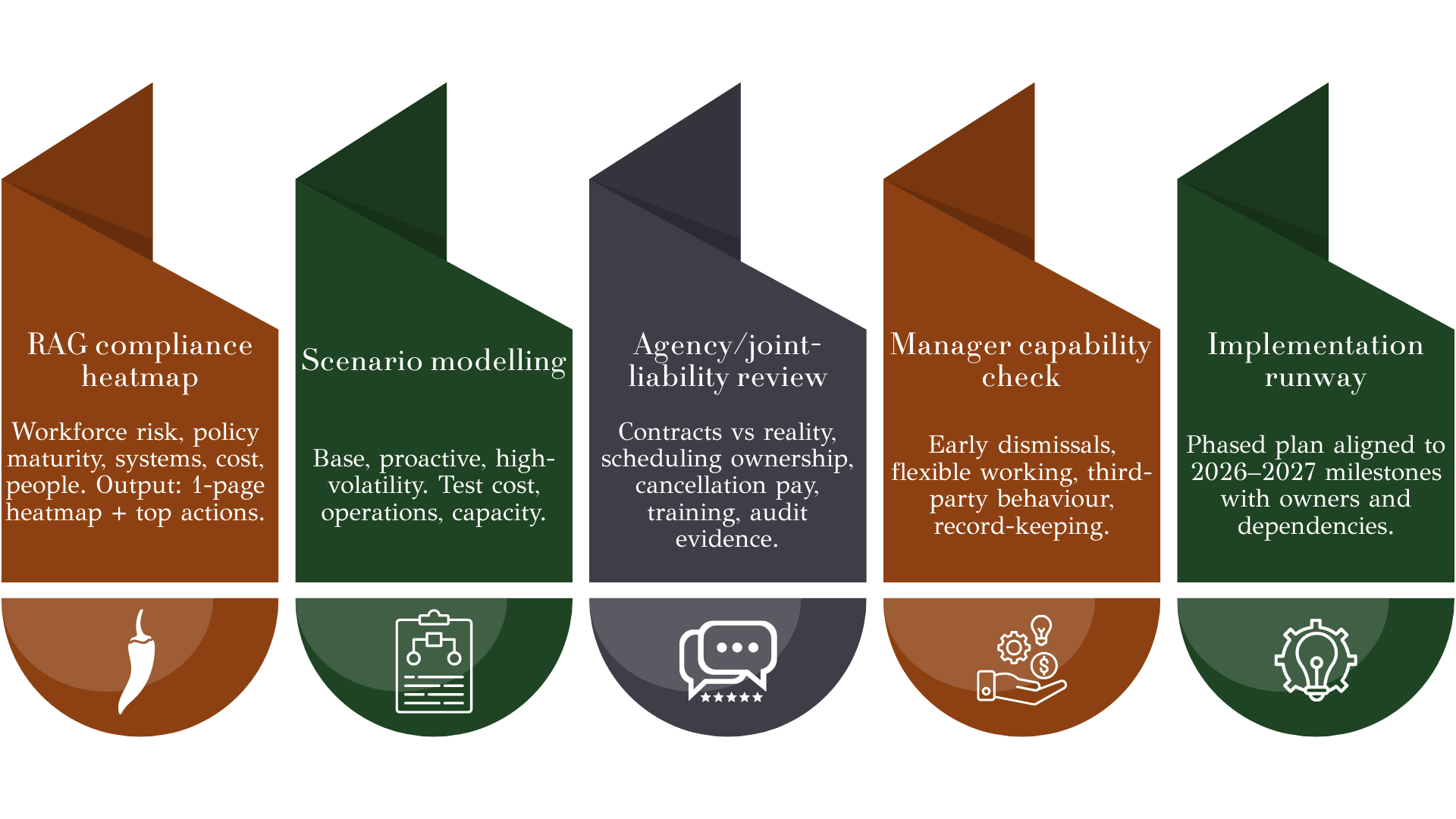
So, what to do?
Fret not! We have this covered.
Over the years (since 1993 to be exact) our change management teams have helped 100’s of clients navigate an ever changing legal, economic, demographic and political landscape – effortlessly and compliantly.
Business impact/risk assessment toolkit